The $50 Exchange, Solved: Wearable Gifts for the Group Chat
Every November, the same thread appears in every group chat in America: "Okay so are we doing a gift exchange this year, and what's the limit?" And every year, roughly half the group panics in a Target aisle on December 22nd and buys a candle.
We love a candle. But a $50 cap is actually plenty of room to give something a person will wear, use, and remember — if you plan around flexibility instead of guessing a size. Here's how to run the whole thing, from the first text to the wrapped box.
The Core Rule: Buy for the Body You Don't Know
In an exchange, you're often buying for someone you know a little — a cousin, a coworker, a friend-of-a-friend whose name you pulled out of a hat. You know their general vibe. You do not know their size, and asking ruins the surprise and creates a weird errand for them.
So the entire edit should be built on one principle: size-flexible or size-irrelevant. Scarves, gloves with a little stretch, beanies, tote bags, slippers in a broad size range, cozy socks, jewelry with an adjustable clasp, a great belt with multiple holes. These are pieces that fit almost everyone and get worn almost immediately. Nothing deflates a $50 gift faster than a sweater in the wrong size that has to be exchanged in January.
Five Archetypes That Land Under $50
Think in categories rather than specific items, and you can shop any store, in any order, at any price point.
The One-Good-Accessory. A chunky knit scarf in a color that flatters most skin tones — camel, charcoal, oat, deep burgundy. Or a leather card case, or a pair of simple hoop earrings. These feel more expensive than they are because they're the kind of thing people use daily but rarely buy for themselves.
The Cozy Upgrade. The nice version of something utilitarian: cashmere-blend socks instead of the multipack, a plush throw, slippers with an actual sole. Under-$50 cozy items hit the sweet spot of useful, giftable, and delightful to unwrap.
The Small-Luxe. One lovely thing instead of three mediocre ones. A silk scrunchie set, a good hand cream in a pretty tube, a compact mirror, a nice candle in a scent that isn't a cliché. This is the archetype that most reliably reads as "considered" rather than "picked up on the way."
The Wear-It-Everywhere Layer. A beanie, a lightweight scarf, a knit headband, a pair of touchscreen-friendly gloves. Especially good for anyone in a cold-weather city, and easy to size because most of these come in one or two generous options.
The Practical Pretty. A structured tote or a small crossbody in a neutral, a folding umbrella in a nice print, a keychain that isn't ugly. These are the gifts people keep and quietly use for years.
The Group Chat Method
Coordination is where most exchanges fall apart — duplicated gifts, mismatched budgets, one person spending $80 to seem generous. Fix it with a light structure.
Set three numbers, not one. The cap ($50), the shipping buffer ($8), and the wrapping ceiling ($6). When everyone agrees the cap includes shipping and wrap, nobody feels quietly outspent.
Draw names in the thread, then move to a shared note. A single running document — name, size hints, colors they actually wear, anything they'd hate — means everyone shops from the same information. Ask for one line: "things I'd never buy myself." That line is the whole game.
Add a deadline two weeks before the actual event. Not for the exchange itself — for the shopping. This eliminates expedited shipping, which is where the budget actually dies.
Include an out for the group. One person always has a tight month. A simple "totally fine to go handmade or secondhand" line in the thread keeps the whole thing warm instead of stressful.
Presentation Is the Cheap Part That Does the Heavy Lifting
A $50 gift that arrives in a crumpled plastic mailer feels like $25. The same gift in tissue paper, tied with a ribbon, feels like $75. This is not a trick — it's just care made visible, and it costs almost nothing.
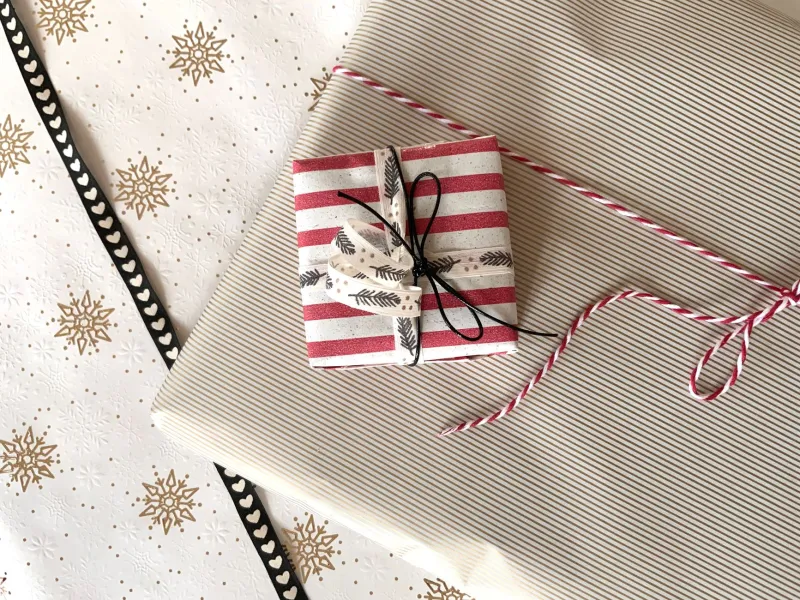
A few things worth keeping on hand through December: a roll of plain kraft or matte black paper, a spool of velvet or grosgrain ribbon, a stack of tissue, and a small box or two saved from earlier orders. Skip the printed bows. A single handwritten note tucked under the ribbon does more than any embellishment on the market.
One detail that makes a real difference: leave the tag on and include the receipt, folded neatly inside the card. If it doesn't fit or isn't quite right, the person can fix it without an awkward conversation. That small allowance is what makes a flexible gift feel genuinely thoughtful rather than a guess you're hoping lands.
A Sample $50 Cart
Say you pulled your sister-in-law's name. You know she commutes, hates being cold, and owns roughly forty pounds of black clothing.
Chunky ribbed scarf in deep burgundy — $28. Cashmere-blend socks, two pairs — $16. A good hand cream in a travel tube — $6. Total: $50 before shipping. Add tissue and ribbon you already own, tuck the receipt in the card, and you're done in one sitting.
That cart works because each piece is something she'd use on a Tuesday in January, when the gift exchange is a distant memory and the scarf is the only thing between her and the wind off the platform. That's the standard, honestly. Not will this look good under a tree — will this be in rotation by February?
Wrap It and Let It Go
Exchanges are supposed to be fun, and they stop being fun when they turn into a stress spiral over getting it exactly right. A wearable, flexible, well-presented $50 gift clears that bar comfortably. Pick an archetype, buy one good version of it, wrap it like you meant it, and let the group chat handle the rest. Somebody's December is about to get a little warmer.